
- Film Title: Blaise
- Directors: Dimitri Planchon, Jean-Paul Guigue
- Writers: Clemence Lebatteux, Dimitri Planchon
- Cast: Timéo (Blaise), Léa Drucker (Carole), Jacques Gamblin (Jacques), Nina Blanc-Francard (Josephine)
- Production: KG Productions
- Country: France
- Format: Animated Feature
- Distribution: The Jokers Films (France, 2026) (theatrical)
- Based On Comic strip series by Dimitri Planchon (Éditions Glénat)
- Festival Trail ACID Sidebar (Cannes 14th May, 2026), Fantasia, July 17th, 2026
- Watched On Festival screening
- Review By Mother of Movies
This review steers clear of plot twists and the grenade’s full journey, but does discuss character arcs and the film’s comedic machinery. Safe to read before watching.
Best Animations to Watch – Blaise – Fantasia Festival 2026
When a family’s defining trait is their complete inability to say no, you’ve got the setup for either a therapy session or a masterclass in comedic sabotage. Blaise is decidedly the latter.
The animation alone demands explanation. Directors Dimitri Planchon and Jean-Paul Guigue built this film from real photographs, an eye from one face, a jaw from another, stitched together Frankenstein-style and mounted onto static, paper-cutout bodies. There are maybe a dozen mouth shapes total cycling through the entire runtime. Everything that matters happens in the eyes. Everything else just sits there, arranged like a diorama while chaos unfolds around it. It’s great and it turns out they ditched a 3D version because the rigidity is the joke.
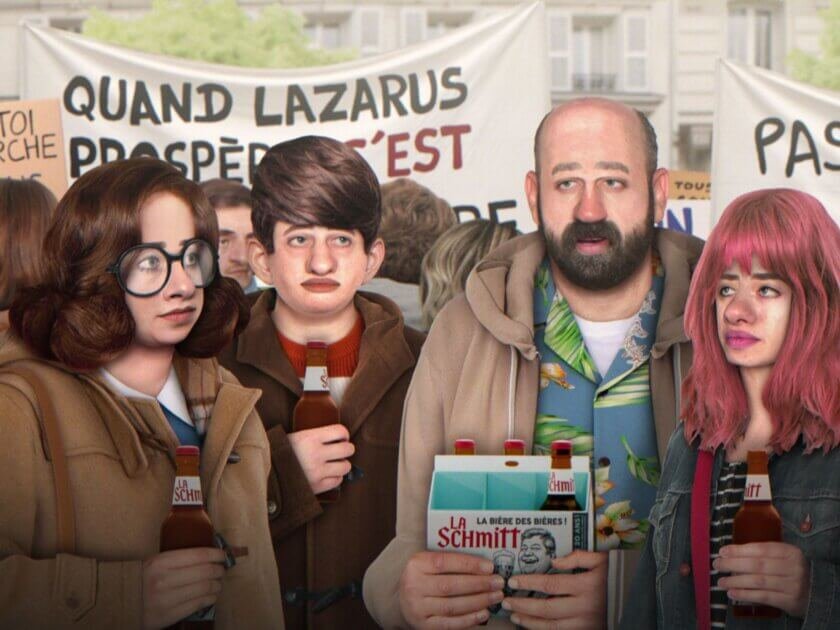
We meet Blaise in the school guidance counselor’s office, where his parents beam with pride when told their son has “qualities.” His mother wonders if this means he’s a genius. The counselor simply says: no. Everyone sits there. Then his father, Jacques, starts unloading his own problems as if he’s the patient. This becomes the film’s first running gag, Jacques keeps returning to trap the counselor into therapy sessions, and she keeps getting ignored when she asks where his son actually is. Later, when something funny happens with a grenade (don’t ask yet), Jacques spends a significant chunk of the runtime tracking her down so he can continue complaining about his allergies.
That’s the tone you’re working with: bone-dry, character-driven absurdism where the punchline lives in the pause before someone does exactly what you’d never do in real life.
Carole, Blaise’s mother, is equally incapable of inserting an argument into her own existence. Her boss tells her flatly that she needs to be more liked, so she throws a small office party, makes one of her three employees cry, and spends the rest of the film trying to walk it back. She invites herself to that employee’s apartment, where it becomes clear the woman thinks Carole’s making a pass at her. Carole doesn’t correct her. She goes along with it. That’s her entire architecture: every decision presented, she accepts.
The plot spirals from there. Blaise gets dragged to a party by his mother’s friend, where he meets Josephine, a girl isolated from her peers because her father is the governor. She likes him enough to insist on driving him home, so he lies about where he lives. She’s lying about hers too, and gets an apartment nearby to maintain the fiction. They become boyfriend and girlfriend.
When a grenade surfaces (courtesy of some activist at the party), it lands in Josephine’s hands, and she assumes it belongs to Blaise, which convinces her he’s some kind of political operative. That assumption cascades into everything that follows.
What makes this work is the writing’s refusal to soften any of it. There’s a recurring thread about Carole’s “tone” being blamed for her stalled career, she thinks she comes across as cool; she doesn’t. If you’ve never been told your tone is the problem, you’re one of the lucky ones. The film knows that wound. It also knows that families like this one actually exist: people who absorb every awkward moment, every uncomfortable truth, every social misstep without ever saying the thing that might save them.
The performances are phenomenal, and they have to be. Every line lands because the actors understand the exact temperature at which to pitch their delivery, just earnest enough that you forget how ridiculous the situation is, until it’s too late. The score punctuates every scene that tips into hilariously off-the-rails with a badaba-daaa, sing-songy flourish that feels like a cartoon watching itself happen.
Verdict & Rating
This is the kind of film that rewards a second viewing because the humor is rooted in specificity. You’ll catch the beats you missed, the micro-expressions, the way a character’s silence says more than any dialogue could. It’s sharp, it’s twisted, and it’s genuinely funny in a way that feels rare right now.
Blaise is rated
4.5 out of 5 Awkward Masterstrokes
A Frankenstein Comedy That Actually Works
Blaise weaponizes awkwardness with surgical precision. Built from stitched-together faces and a dozen mouth shapes, this animated dark comedy about a family incapable of saying no becomes an unexpectedly brilliant study in how we sabotage ourselves. Dry, twisted, and endlessly rewatchable.

Streaming Options for Blaise
Blaise is streaming on:
“A family that never pushes back, a grenade that changes everything, and dialogue so precise it lands like a scalpel.”
— Mother of Movies
Similar and Like Minded Films
Anomalisa (2015) — Stop-motion character study about human connection and the masks we wear. Similarly unsettling visual approach paired with intimate emotional stakes.
Greener Grass (2019) — A festival favorite from years ago, this one builds a world where everyone’s in competition.
The Lobster (2015) — Absurdist dark comedy about social pressure and the refusal to conform. Shares Blaise’s deadpan tone and escalating surrealism.
Werewolf (2023) — Animated feature about family dysfunction and communication breakdown. Similar use of visual constraint to amplify emotional tension.
To Your Last Death (2020) — This movies is nothing like Blaise. But, it is an annimation, it’s horror and it’s criminally not watched enough.
Blaise
Director: Dimitri Planchon, Jean-Paul Guigue
Date Created: 2026-05-14 14:43
4
