
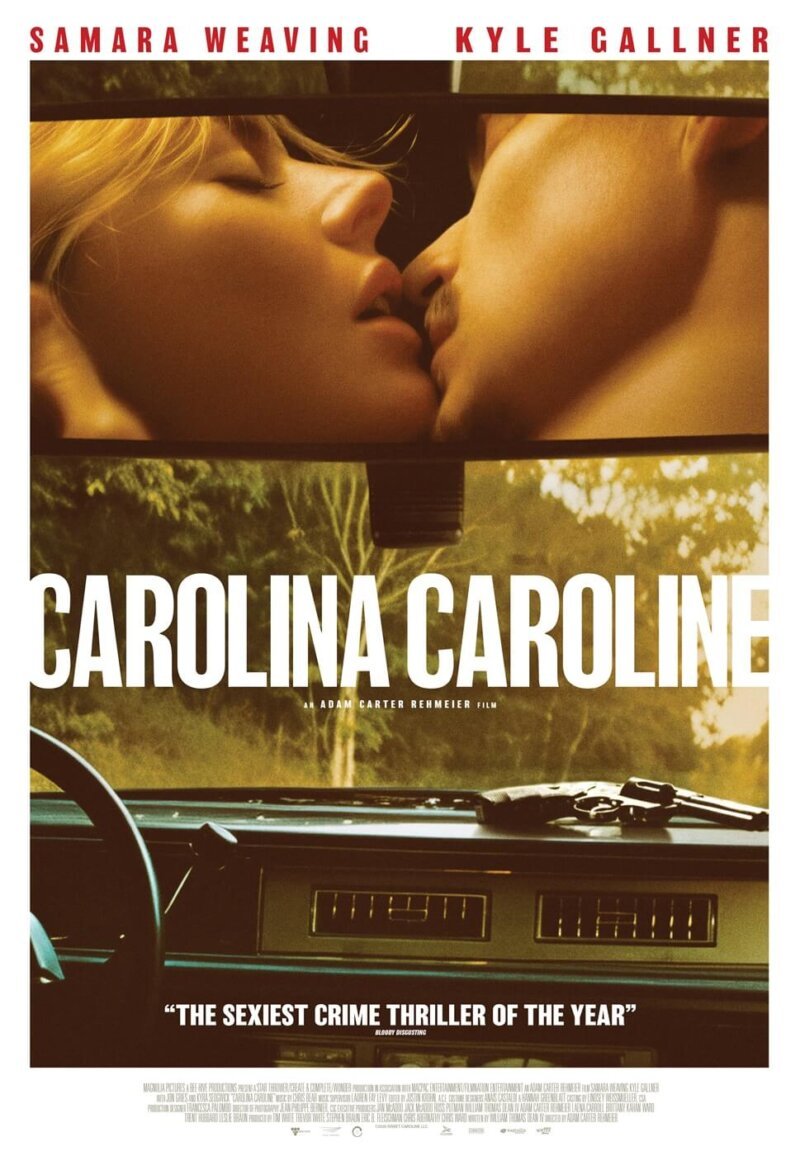
Carolina Caroline
Director: Adam Carter Rehmeier
Date Created: 2025-09-05 15:14
4
Pros
- 70s visual language grounds the film in place and time rather than nostalgia-baitings
- Moral Complexity Without Hand-Wringing
- Pacing That Moves Like a Getaway
- Country Soundtrack as part of the film's DNA
Cons
- Mother Subplot Feels Tacked On
- Limited Supporting Cast Development obligatory rather than essentials
- Predictable Crime Escalation
- Thin on Social Commentary, but does it need it?
- Film Title: Carolina Caroline
- Cast: Samara Weaving (Caroline Daniels), Kyle Gallner (Oliver), Kyra Sedgwick (Caroline’s Mother), Jon Gries (Caroline’s Father), Jason Isbell (cameo)
- Director & Writer: Adam Carter Rehmeier (Director); William Thomas Dean IV / Tom Dean (Writer)
- Distribution: Magnolia Pictures
- Production: Runtime 105–106 minutes | Rated R | Filmed in Kentucky
- Release Date: Limited theatrical release June 5, 2026 (following TIFF premiere September 5, 2025)
- Watched on: Advanced Screener
- Review by: Mother of Movies
This review is spoiler-free through the midpoint. The final act’s outcome is not discussed, but thematic weight is fair game.
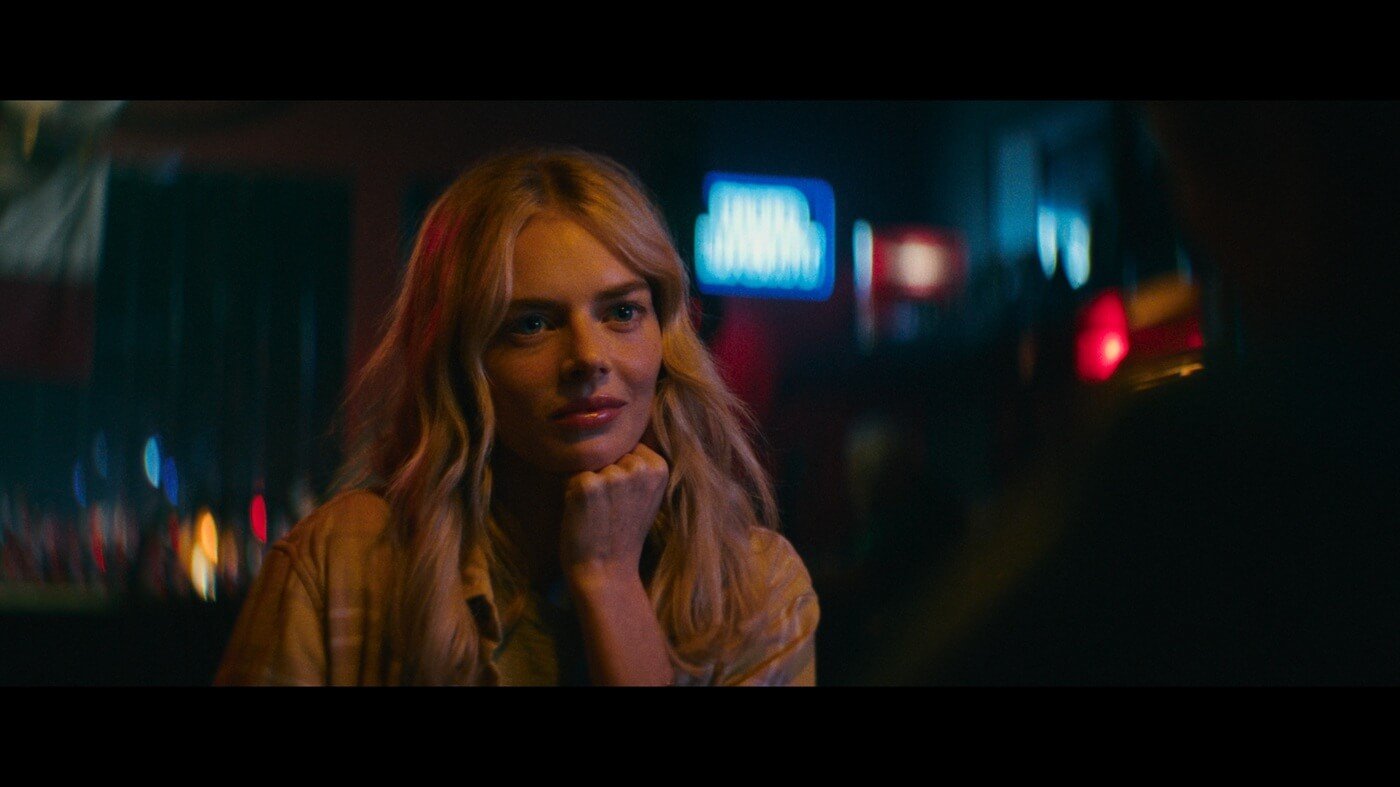
Carolina Caroline (2026): When Bonnie Met Clyde in a 70s Fever Dream
Rehmeier’s Carolina Caroline moves like a 70s getaway car through rain, all velocity and mood, no wasted motion. The film doesn’t need plot mechanics to survive. It survives on two people who shouldn’t be on screen together but are, and the moment they share space, nothing else matters.
Caroline works a gas station in a Texas nowhere. Oliver rolls in to con the owner. She clocks him immediately, not as a mark, but as an exit. She finds him later, and they talk. That’s the entire setup. No elaborate meet-cute, no destiny-coded nonsense. Just two people recognizing something in each other that feels like permission to stop pretending.
Weaving plays Caroline with a kind of feral curiosity, she’s not naive, she’s eager. There’s a difference. She watches Oliver move through the world and decides she wants to learn his language. Gallner’s Oliver has the surface charm of someone who’s survived by reading rooms, but there’s something underneath that reads as genuine. Not reformed, not secretly good. Just present in a way that matters to her. Their first dance scene, where he plays a song she mentioned, has more intimacy than most films manage in their entire runtime. He was listening. He remembered. He cared.
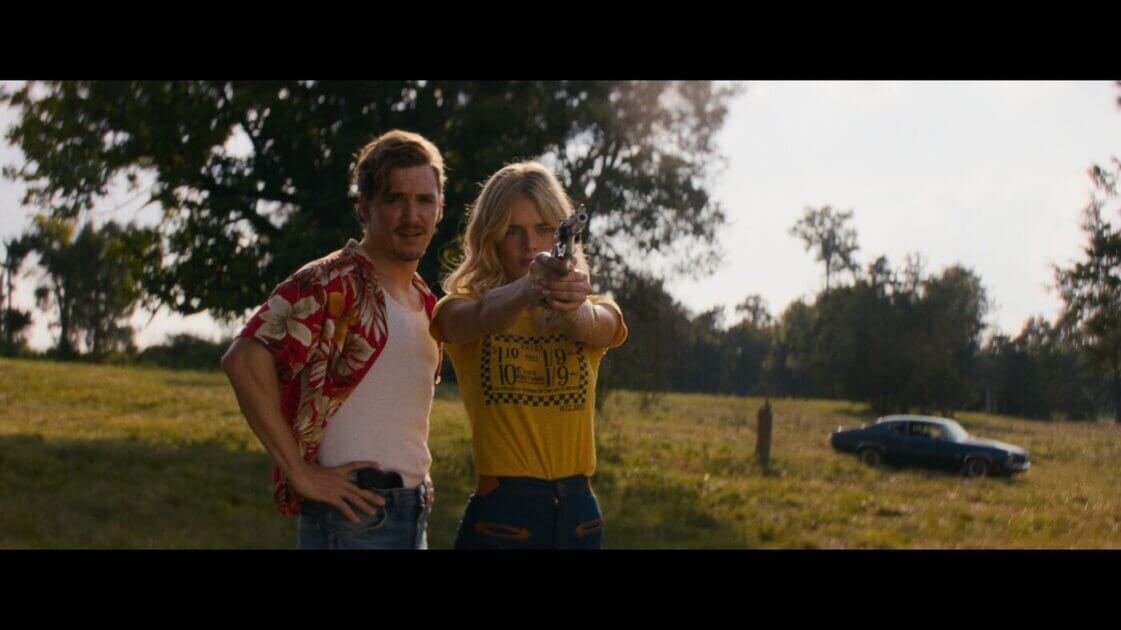
What follows is a crime spree that escalates with the kind of logic that only makes sense inside a relationship. They rob banks. Caroline holds the gun. Oliver drives. They’re competent at the theft itself but utterly unprepared for what comes after, the aftermath, the bodies, the moral weight. Caroline vomits after the first real violence. She doesn’t stop, though. She doesn’t even seriously consider stopping. The film doesn’t judge her for this; it simply observes her choosing him over her own conscience, over safety, over the person she was before.

Rehmeier shoots everything in a retro palette, 70s cars, period-appropriate clothing, banks that look like they exist outside time. Cinematographer Christopher Bear bathes scenes in warm amber and deep shadow, so the film feels like you’re watching it through old Kodak stock. The effect isn’t nostalgia exactly; it’s more like the movie knows it’s telling a story that’s been told before, and it’s choosing to honor that lineage rather than run from it. The Bonnie and Clyde comparison is unavoidable, but Carolina Caroline isn’t interested in mythology. It’s interested in the mundane moments between heists, the conversations, the silences, the way two people can become a closed system that doesn’t need the outside world to validate it.
The soundtrack uses country artists like Chris Stapleton and Loretta Lynn not as window dressing but as emotional scaffolding. There’s a specificity to the music that grounds the film in place and time. Christopher Bear’s original score sits underneath it all like a pulse, steady and hypnotic.
Where the film falters is in its handling of Caroline’s mother subplot. Yes even when the actress is on-screen royalty Kyra Sedgwick. The reunion scene is deliberately dark, bittersweet doesn’t cover it, but the thread feels inserted rather than woven. It works thematically (Caroline searching for something she can’t find, a reason to go home that doesn’t exist), but it interrupts momentum. The father subplot, was nice until it wasn’t. Caroline didn’t need additional fuel to justify her part in it.
Caroline does ask herself if they’re good people pretending to be bad or vice versa. She queries why their crimes don’t hurt the “little people”, she’s not operating without moral awareness. She knows what they’re doing is wrong. She does it because he matters more than the alternative. That’s not moral confusion; that’s al choice made with open eyes. The film trusts its audience to sit with that discomfort without offering absolution.
The ending doesn’t give you the sunset ride-off. It doesn’t give you redemption either. What it gives you is consequence, not punishment, but the natural conclusion of two people who loved each other more than they loved survival. That’s a different kind of tragedy, closer to Romeo and Juliette than to outlaw mythology, but like Bonnie and Clyde style.
Weaving and Gallner carry this film on their backs, and they do it without breaking a sweat. There are stretches where nothing happens except them talking, and you stay locked in because the chemistry is that complete. Gallner especially has a gift for playing characters who seem charming until you realize the charm is just him being present, no manipulation underneath, just attention. Weaving’s Caroline is the film’s moral center precisely because she has agency. She’s not unmoored; she’s making deliberate choices. She’s uncompromising, and that’s what makes her dangerous and sympathetic in equal measure.
Is Carolina Caroline worth your time?
If you’re looking for a film that trusts its leads, that moves on mood and chemistry, yes. If you need resolution or moral clarity or a reason to root for your protagonists beyond the fact that they’re beautiful together, you’ll find the experience frustrating. The film doesn’t care about your comfort. It cares about theirs.
Rating and Verdict for Carolina Caroline
Carolina Caroline is rated
4 out of 5 Retro-Soaked Crimes of Passion
Two People Who Shouldn’t Work But Do
Samara Weaving and Kyle Gallner have a chemistry so effortless it feels dangerous. Rehmeier’s film knows this and builds everything around it—a retro-soaked crime romance that moves like heat lightning across dry grass, leaving you wondering if what you’re watching is beautiful or catastrophic, or somehow both.
Adam Rehmeier Traits We Love
Adam Carter Rehmeier has built a small but devoted following with films like Dinner in America and Snack Shack. They are projects that prioritize character and mood over conventional narrative momentum. His signature move is taking ordinary people in confined spaces (gas stations, small towns, interpersonal relationships) and finding the electricity in their interactions. He works frequently with cinematographer Christopher Bear, and that collaboration has developed a visual language that’s distinctly it’s own bubble.
Similar Titles to Carolina Caroline
Need more outlaw romance with teeth?
- Bonnie and Clyde (1967) — The obvious reference point. Young lovers, crime spree, doomed trajectory. Beatty and Dunaway set the template Rehmeier both honors and subverts.
- A Safe Distance (2026) — Bank robbers and a woman named Alex who finds something more in the woods than she expected.
- Good Time (2017) — Safdie brothers’ one-night crime thriller. Robert Pattinson as a con man spiraling. Similar intensity and moral ambiguity.
- Twisted (2026) – Not lovers, but twins who run a hustle only to run it on the wrong mark.
- Badlands (1973) — Malick’s lovers-on-the-run masterpiece. Poetic, violent, and utterly committed to the romance despite its darkness.
- Two-Lane Blacktop (1971) — Hellman’s road film with minimal plot and maximum mood. Like Carolina Caroline, it’s more about the space between moments than the moments themselves.
- Villains (2019)– If good looking couples doing crime is your thing, this film stars Maika Monroe and Bill Skarsgard.
Carolina Caroline 2026: Retro Crime Romance That Delivers – Where to Stream
Carolina Caroline is streaming on:
“Two people who shouldn’t work but do, their chemistry so effortless it feels dangerous.”
— Mother of Movies
