
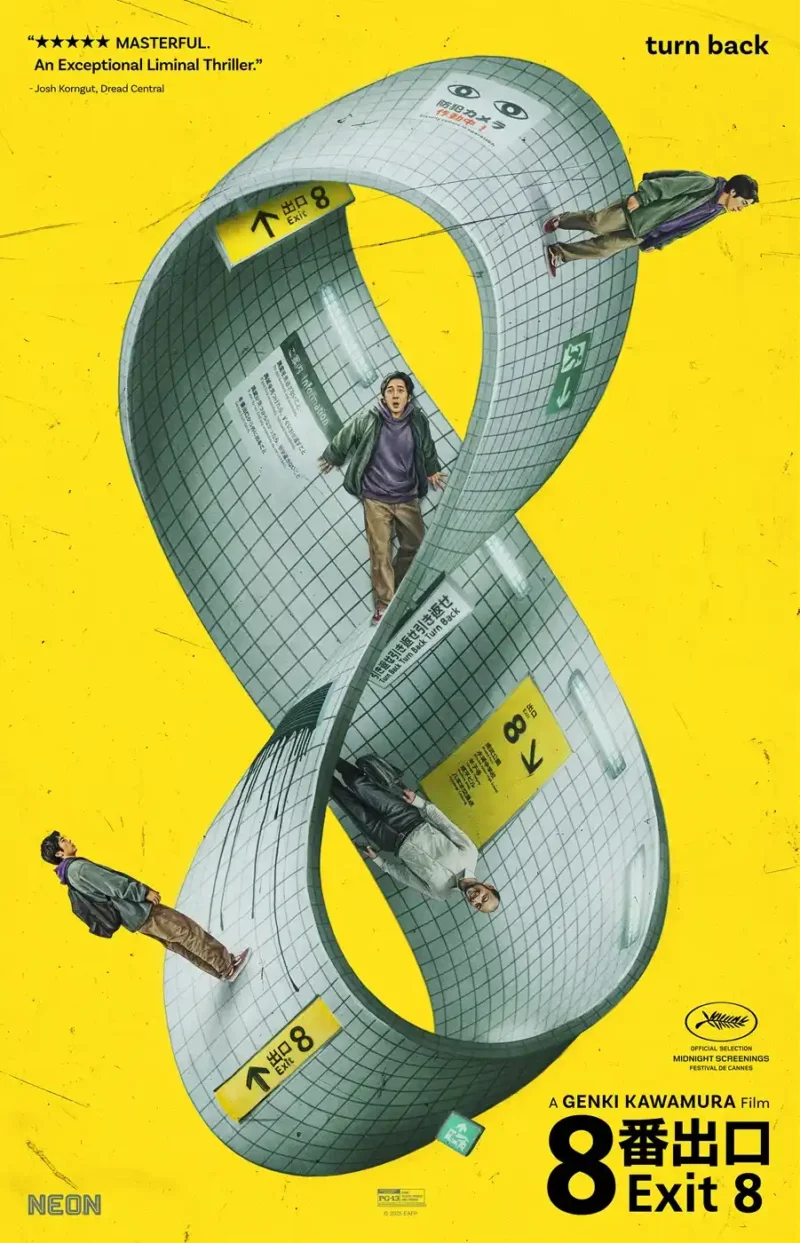
- Film Title: Exit 8
- Cast: Kazunari Ninomiya (Lost Man), Yamato Kochi (Walking Man), Naru Asanuma (The Boy), Kotone Hanase, Hirota Ôtsuka, Tara Nakashima, Reo Soda, Mikio Ueda
- Director: Genki Kawamura
- Writers: Kentaro Hirase, Genki Kawamura (based on the video game by Kotake Create)
- Distribution: NEON (US), Umbrella Entertainment, Elevation Pictures
- Production Companies: AOI Promotion, Story Toho
- Release Date: 2025 (Premiered Cannes Film Festival Midnight Screenings May 19, 2025) Limited release in the USA April 10th, 2026 – Wide release by NEON
- Review by: Mother of Movies as remote press for Overlook Film Festival
- Official Website for Exit 8 (2026)
This review contains major thematic discussion and plot structure details. We don’t reveal specific anomalies or the exact mechanism of the loop, but we discuss how perspective shifts function as narrative device. Watch it cold for maximum disorientation.
Exit 8 Explained – A Walk Through
It’s the moment you realize you’re not the only consciousness trapped in the same loop, and you’re all experiencing it differently.
Genki Kawamura, producer of Your Name and Suzume, marking his second film as director. It takes the Tokyo Metro and turns it into a recursive hell where the only way out is to stop trying to escape alone.
Exit 8 opens with a packed train. Suited bodies. Everyone scrolling. Kazunari Ninomiya’s character, the Lost Man, is barely visible at first, just a reflection in the carriage window. He’s on his phone. His girlfriend calls. She’s pregnant. He tells her he can’t decide. The reception crackles. It cuts out. That’s the last time we hear from the outside world.
After that we follow him into the subway tunnels, but the perspective doesn’t stay with him. It shifts.
The Lost Man walks through empty tunnels. We see what he sees, fluorescent emptiness, the hum of nothing. Then there’s a photo booth. A blanket. A man in a white shirt walking towards him. Over and over, then a small boy appears. The screen shifts into the next video game controller mode: THE LOST MAN. We’re watching him now.
The Viewpoint Fracture: Where the Real Anomaly Lives
He keeps walking. The tunnel loops. He passes the man in the white shirt again. And again. The score, a flute, intermittent, like a train stopping but softer, creates the sensation of being caught between departure and arrival. Ninomiya’s performance is key here. He’s not panicking. He’s noticing. His breathing is slightly labored (asthma, we learned from the opening). He’s trying to solve follow the instructions, but he keeps returning to level 0.
Then the screen shifts again. THE WALKING MAN.
Yamato Kochi, carrying a briefcase like it’s the only thing tethering him to identity, is in the same tunnel. The Walking Man is trying to get out of the tunnels as well. He sees a woman. He talks about being on his way to meet his son. He’s moving with purpose, but he knows he’s trapped.
And then: THE BOY.
Naru Asanuma’s child character is the film’s fracture point. A small figure in the tunnel before a viewpoint shift, and then we realize he was already with the Walking Man. The boy is trying to show him something. Anomalies. The lights are wrong. The exit signs are wrong. The door handles are wrong.
This is where Exit 8 separates itself from typical loop horror. The film doesn’t trap us in one perspective. It fractures us across three. And each character experiences the subway tunnel differently because each one is carrying different weight into it.
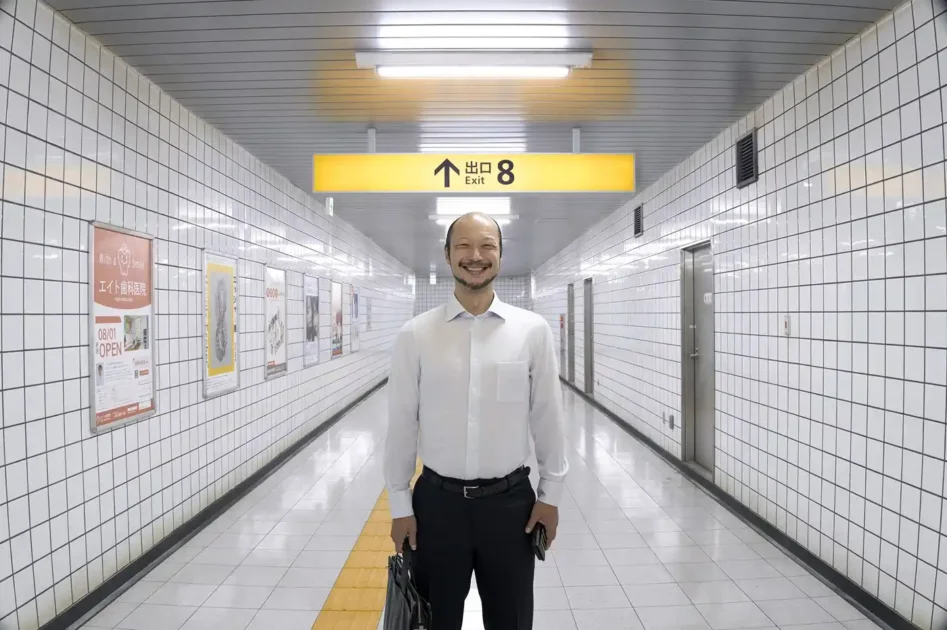
The Anomalies Are the Map
The Lost Man takes photos. Obsessively. He’s documenting so he can remember. There’s blood streaming from ceiling signs, exits that shift from 1 to 0 again. He’s trying to find a pattern. He’s trying to think his way out. The rules are clear. See an anomaly and turn back. See none and keep going. But sometimes, changes are hard to spot.
The Walking Man just walks. He passes the woman. He’s moving fast, which feels like progress, but progress toward what? He climbs he levels quickly.
The Boy can see the anomalies. He’s not trapped in the same way. He’s moving between states and he’s the only one who seems to exist in multiple versions of the tunnel simultaneously. When he tries to warn the Walking Man, he doesn’t listen. When they next meet, the Lost Man calls him a monster. The Walking Man chose the briefcase. He chose to ignore the boy’s guidance. He chose to take an exit that wasn’t his to take.
But the Lost Man chose differently.
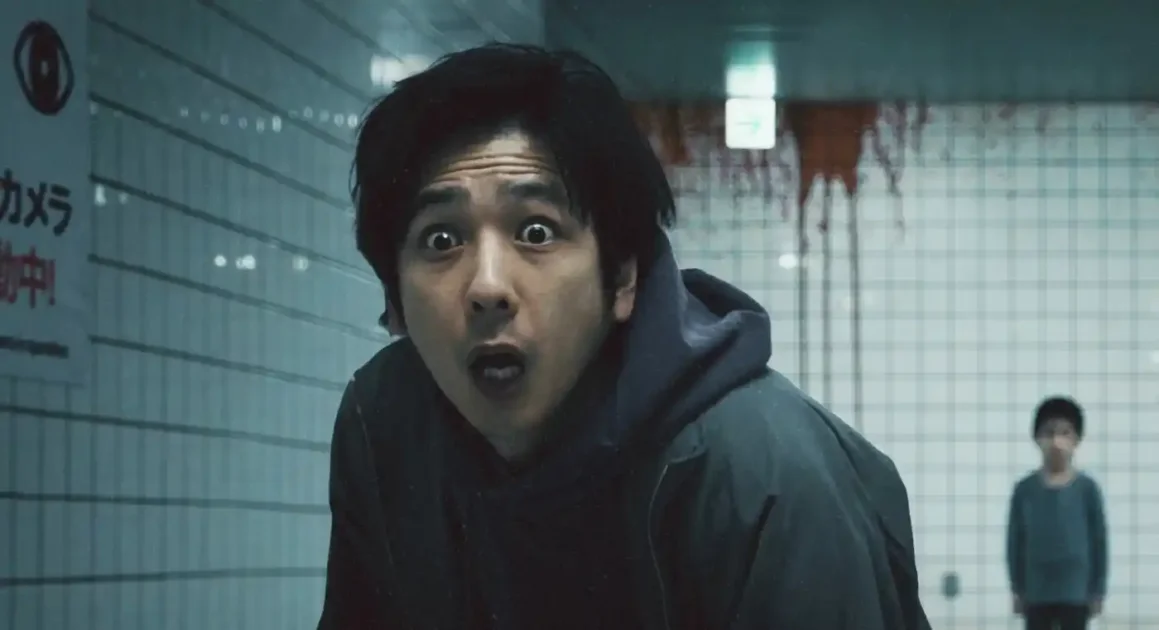
The Moment That Breaks the Loop
There’s a scene where the Lost Man and the Boy are together, and the Lost Man sees something: a flash of his future. Not a memory. A possibility. Him with the boy. With his son. The version of himself that made a different choice on that train. The version that said yes.
That’s when the film pivots. Not because the tunnel changes. Because his willingness changes.
He starts to listen to the boy. He starts to see the anomalies the way the boy sees them. The exits climb: 3, 4, 5. They’re not just numbers anymore. They’re states. Each exit is a version of the tunnel. Each version is slightly more real than the last.
There’s a moment with water. Flooding. The Lost Man saves the boy. And in that act, in choosing to protect something other than his own escape, he finds the actual path forward.
The Game vs. The Film (Exit 8)
The source material is a 2023 indie game by solo developer Kotake Create: a first-person walking simulator in which you move through a looping subway corridor, scanning for anomalies and turning back when you find one. That’s essentially the whole game. No story, no character, no reason to escape beyond a set of rules posted on a wall. The exit counter climbs from 0 to 8. Progress or loop back. Repeat.
The film keeps the rules, the corridor, and Briefcase Man, who in the updated version (released to coincide with the film) literally follows you when you look away, as if the universe built here updated itself around the movie’s character. What the film adds is everything else: the pregnancy, the guilt, the choice. Ninomiya, a gamer who knew the source material firsthand, received a script cooperation credit for helping Kawamura build narrative around an interactive original that had none.
The key difference is where the horror lives. In the source material, you are scanning for wrongness, the threat is your own inattention, and missing an anomaly is a failure of perception. The film can’t replicate that. What Kawamura does instead is multiply perspectives: three characters who each represent a different way of being the player. The Lost Man reasons his way through. The Walking Man ignores. The Boy intuits. It’s a clever structural answer to an adaptation problem that’s defeated better-resourced filmmakers, and it works.
At the end of Exit 8, Lost Man boards the train again. He’s back where he started. The same packed car. The same phones. The same girlfriend calling. But this time, in the last frame, he takes his headphones out. He’s going to defend the woman. He’s going to intervene. He’s going to choose connection instead of isolation.
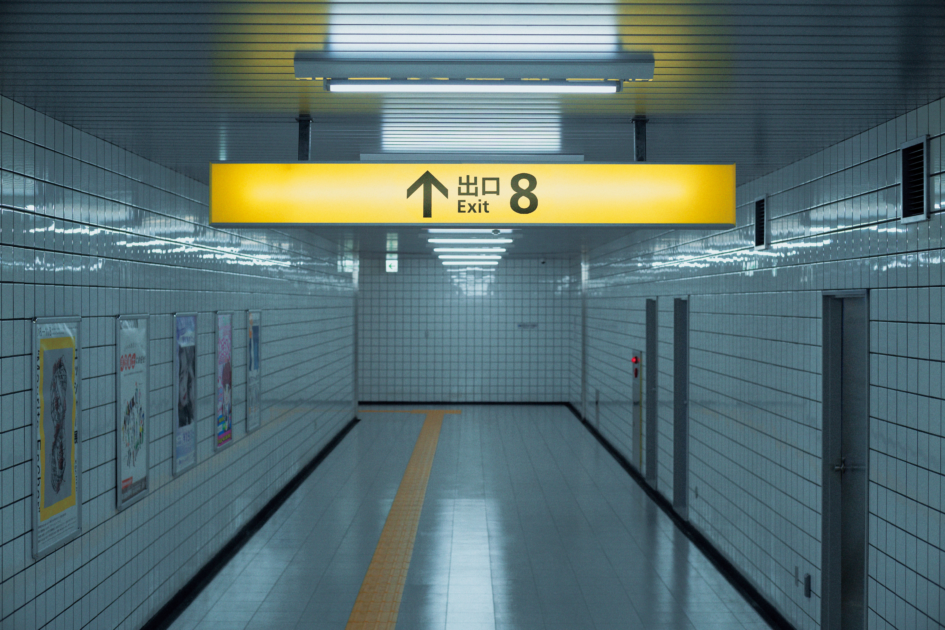
The Viewpoint Shifts as Narrative Device
What makes Exit 8 impactful is that it refuses to let you settle into one perspective. The viewpoint shifts aren’t glitches. They’re the point. We’re not watching three people trapped in the same tunnel. We’re watching three different versions of the same trap, and they occasionally intersect.
The film has been read by some as pro-life commentary, the Lost Man’s arc, the pregnancy, the final choice to intervene. Kawamura has pushed back on that reading, and the film gives the more expansive interpretation: it’s about choosing life in all its forms. Choosing to see the people around you instead of scrolling past them.
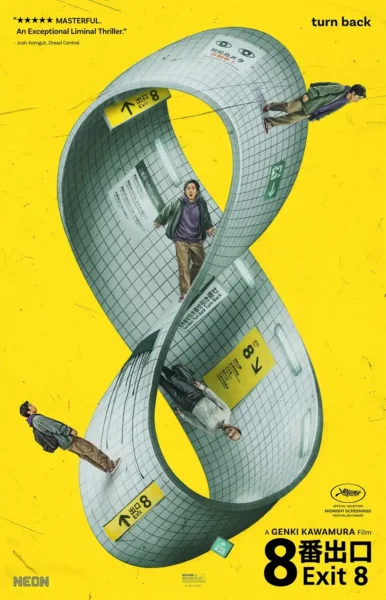
Cinematographer Keisuke Imamura shoots the tunnels not as claustrophobic but as indifferent. The score is sparse and quiet more than noisy, creating the sensation of a train whose doors keep opening without ever quite departing. Exit 8 grossed ¥5.2 billion in Japan and premiered to an eight-minute standing ovation at Cannes Midnight Screenings (out of competition, though it won Best Poster Design). It is the rare video game adaptation that solves its source material rather than merely adapting it.
Exit 8 is Rated
3.5 Crying Babies on Trains out of 5
Recursive Nightmares That Demand Rewatching
Exit 8 fractures perspective across three trapped souls in an endless Tokyo subway. Genki Kawamura’s recursive horror understands that the real exit isn’t a door — it’s choosing connection over isolation. Anomalies hide in plain sight.
Similar Titles Section: Trapped in the Connection of Survival
Need more? Films like Exit 8 are:
- Pulse (2001, Kiyoshi Kurosawa) — Japanese horror, spiritually aligned with Exit 8’s philosophy of connection as survival.
- Backrooms (2026) — The biggest independent feature film to knock it out of the park in recent years. Must Watch.
- Ghostland (2018, Pascal Laugier) — A film that refuses to settle into one narrative viewpoint, forcing the viewer to piece together truth from multiple angles.
- It Ends (2025) — Existential dread, this one is just a car on the road. Where will they end up?
- The Wailing (2016, Na Hong-jin) — Multiple characters trapped in cycles of choice and consequence. The ending reframes everything you thought you understood.
- Resident Evil (2026) — Based on the Playstation favorite, see this one the biggest screen you can
- Come True (2020, Kyle Mooney) — A film about being trapped in states of consciousness. Visually sparse, philosophically dense.
Exit 8 2026 Is Streaming On
Exit 8 is streaming on:
“The only way out is to stop trying to escape.”
— Mother of Movies
Exit 8
Director: Genki Kawamura
Date Created: 2025-05-19 11:43
3.5
